What Happens to Satellites During a Solar Eclipse?
Satellites do not all go dark when the Moon covers the Sun. A satellite only loses solar power when its own orbit carries it into a shadow, and that routine dip is handled by onboard batteries, not by the eclipse below.
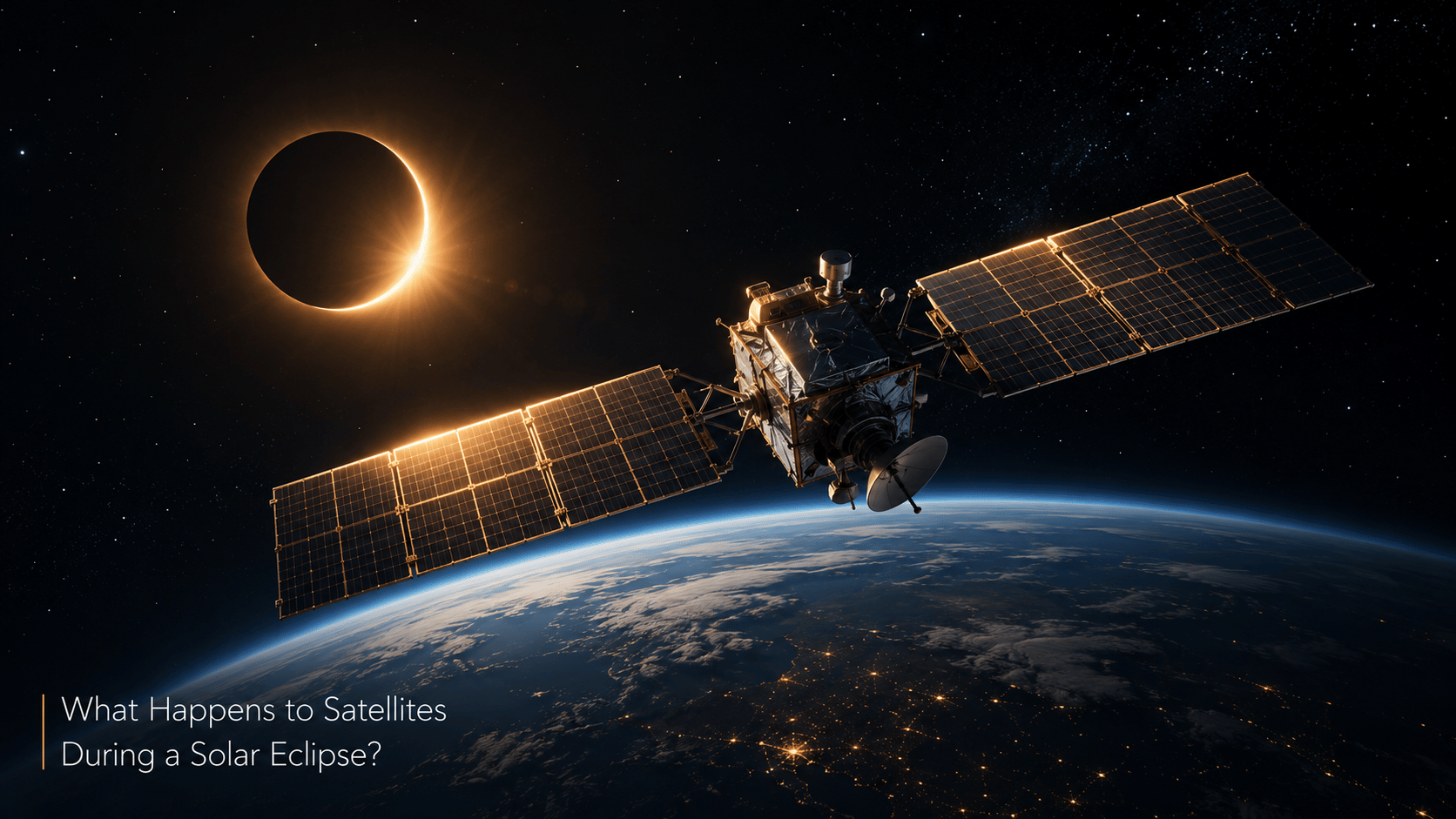
Satellites do not all lose power during a solar eclipse. The overwhelming majority keep operating normally. A spacecraft only sees its solar panels dim when its own orbit carries it into a shadow that blocks the Sun, and satellites are built to run on onboard batteries through exactly those periods. The eclipse you watch from the ground is a different event from the shadow a satellite passes through in orbit.
On 12 August 2026, the Moon’s shadow will sweep from the Arctic across Greenland and Iceland, over the North Atlantic, and onto northern Spain, producing the first total solar eclipse over mainland Spain since 1905.[2] It is a natural moment to ask a question that sounds simple but hides a common misconception: what actually happens to the thousands of satellites overhead when the Moon covers the Sun?
The confusion comes from one word doing two jobs. “Eclipse” describes both the rare event where the Moon’s shadow touches a narrow track on Earth’s surface, and the routine event where a satellite slips into Earth’s own shadow on the night side of its orbit. They are unrelated. Toggle the diagram below to see the difference.
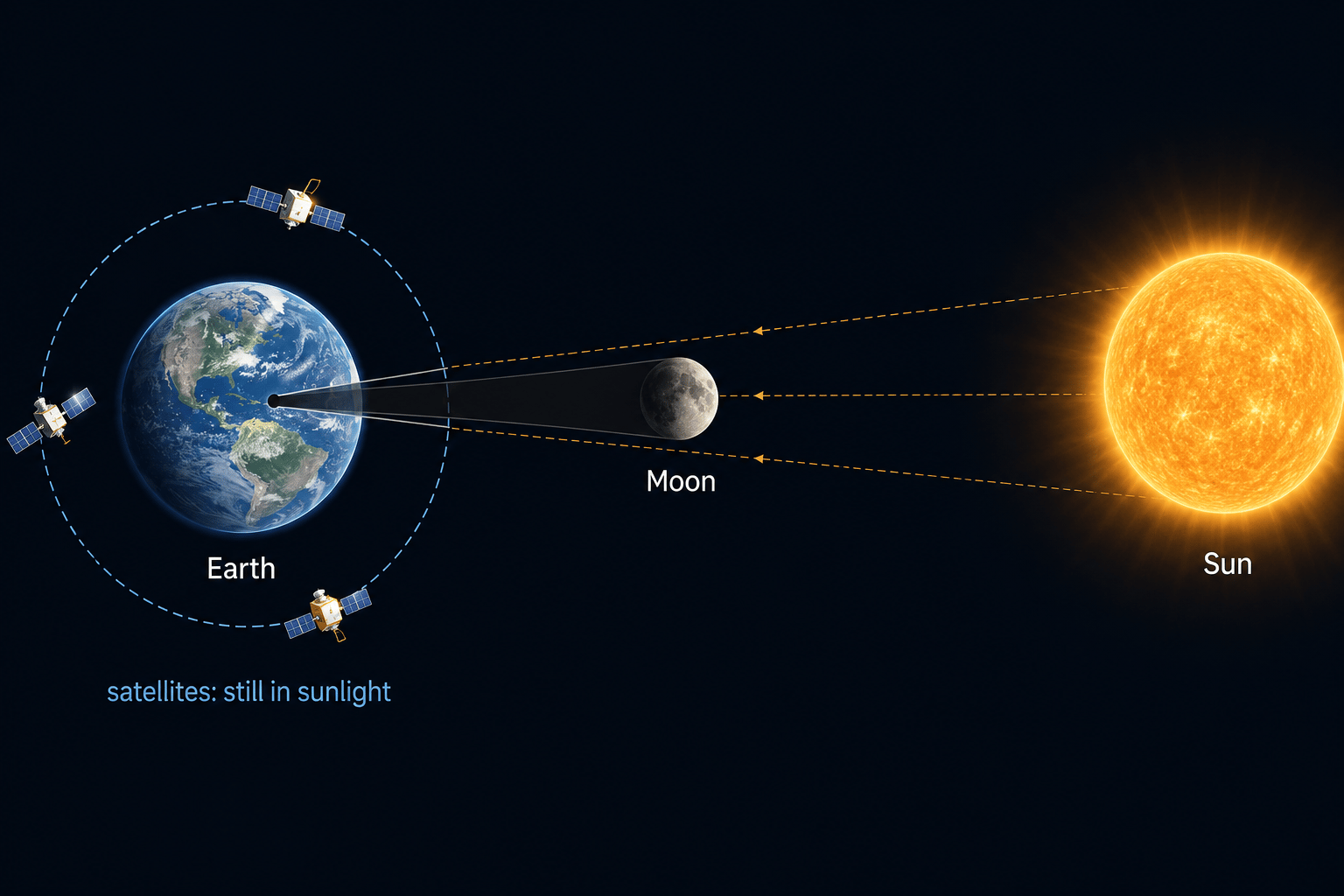
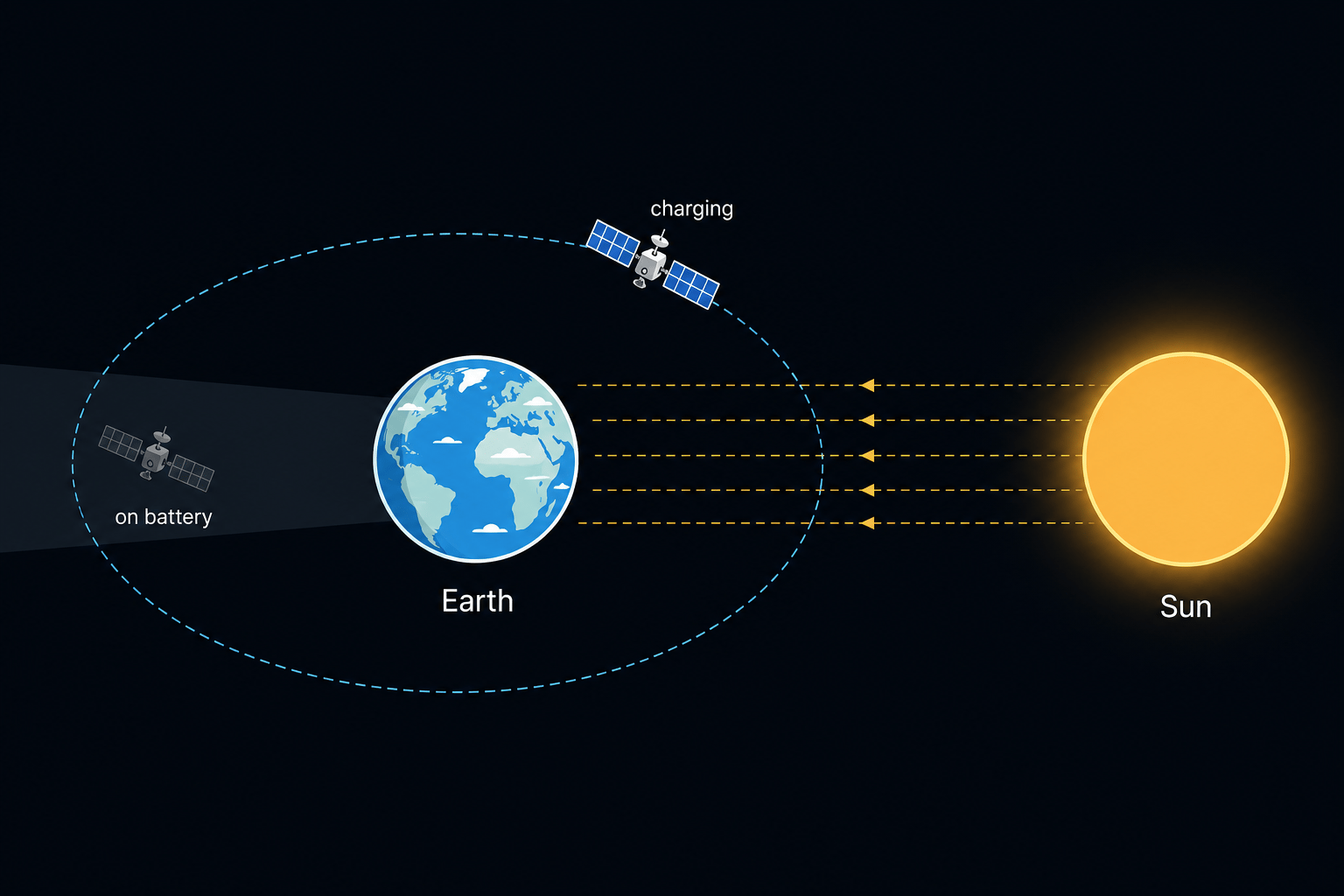
A solar eclipse on the ground: the Moon’s shadow narrows to a small track on Earth’s surface (the path of totality). Satellites in orbit are almost never inside it, so they stay in full sunlight and keep working.
Solar eclipses on Earth vs. eclipses in orbit
A total solar eclipse happens when the Moon passes directly between the Sun and Earth, and its shadow falls on the planet.[1] That shadow is small. During the 2026 eclipse the path of totality, the strip where the Sun is completely covered, is only about 293 kilometres wide at its broadest, and totality lasts at most roughly two minutes and eighteen seconds at the point of greatest eclipse in the ocean southwest of Iceland.[4] NASA describes totality more loosely as under two and a half minutes for everyone on the path.[1]
A satellite’s “eclipse” is something else entirely. As it circles the planet, a satellite regularly passes behind Earth into the planet’s shadow, where the Sun is hidden. In low Earth orbit this happens on every lap: the International Space Station completes about 16 orbits a day, passing through 16 sunrises and 16 sunsets in 24 hours.[5] Geostationary satellites, parked far higher, spend most of the year in continuous sunlight and only enter Earth’s shadow during two roughly six-week “eclipse seasons” centred on the March and September equinoxes.[6] Crucially, all of this is governed by the satellite’s orbit and the calendar, not by the Moon and not by any eclipse you can watch from the ground.
Do satellites lose power during a solar eclipse?
For the vast majority of satellites, no. The Moon’s shadow on 12 August 2026 is a strip under 300 kilometres wide crossing Earth’s surface.[4] Satellites in orbit are almost never inside that strip; they remain in full sunlight and keep working exactly as they do on any other day. The only power event that reliably dims a satellite’s panels is entering Earth’s shadow, which, as we saw, is a routine part of orbiting and has nothing to do with the solar eclipse below.
There is one genuine nuance worth stating carefully. The Moon’s shadow does not stop at Earth’s surface; it extends as a cone through space, and a satellite can pass through it. ESA’s Sun-watching Proba-2 spacecraft, in a low orbit, dipped in and out of the Moon’s shadow during the 2017 eclipse and recorded three separate partial eclipses in a single event.[17] So a satellite briefly receiving reduced sunlight because it sits inside the Moon’s shadow in orbit is a real, documented phenomenon.
So how much power would a satellite actually lose if it did pass through the Moon’s shadow? No space agency has published a measured figure for a spacecraft, so what follows is a first-principles estimate, labelled clearly as ours. A solar panel’s electrical output is roughly proportional to the sunlight reaching it, which in turn is proportional to how much of the Sun’s disk is still visible. There is a strong ground analog: during the 2017 US eclipse, California’s utility-scale solar output fell about 60 percent, from roughly 9.1 to 3.6 gigawatts, while the Moon covered about 60 to 70 percent of the Sun. Output tracked the obscuration closely.[22] [23]
How much of the Sun is blocked sets how much power the panels make.
Applying the same optics to a spacecraft: if a satellite were inside the Moon’s shadow, we estimate its panel output would fall in rough proportion to how much of the Sun is covered from its vantage point, from a slight dip at the faint edge of the shadow (the penumbra) toward near-total loss during the brief seconds to minutes it might spend in the full shadow (the umbra), then a complete recovery. That umbral passage is short, and any onboard battery would ride through it without trouble, which is exactly what batteries are for.
[!]Where this estimate stops (and what we will not claim)
How batteries keep satellites operating
Satellites make electricity from solar arrays, the wing-like photovoltaic panels you see in spacecraft photos. When the panels are in sunlight they run the spacecraft and charge a bank of rechargeable batteries; when the spacecraft enters shadow, those batteries take over, then recharge once it returns to daylight.[6] Modern satellites almost always use lithium-ion batteries, the same chemistry family as a laptop or phone, sized specifically for the worst-case shadow period.[7]
The demands differ sharply by orbit. A low-orbit satellite runs its battery briefly but does so thousands of times a year, one shallow discharge per lap. A geostationary satellite discharges at most once a day, but for longer: at the peak of an eclipse season the daily shadow reaches about 72 minutes before a long recharge in sunlight.[8] Either way, running on battery through darkness is a designed-for, everyday behaviour, not an emergency.
Are communications, GPS, weather and Earth-observation satellites affected?
The satellites themselves are not. What a solar eclipse briefly changes is the ionosphere, the electrically charged layer of the upper atmosphere that sits between the ground and the spacecraft. When the Moon blocks the Sun’s ultraviolet and X-ray light, the ionosphere partly relaxes, which changes how radio signals pass through it.
This is measurable. During the 2017 total eclipse over the United States, a dense network of ground receivers recorded drops in ionospheric total electron content, in some places greater than 60 percent, that affected GPS and other satellite-navigation signals.[10] Radio operators, coordinated by the NASA-supported HamSCI project, documented how the same relaxation temporarily reshaped long-distance HF radio propagation.[11] [12] The key point for this article: it is the signal path through the ionosphere that is disturbed, not the navigation or communications satellite in orbit, which keeps transmitting normally.
How satellites photograph the Moon’s shadow crossing Earth
If most satellites are unaffected, the more interesting story is what they can see. Weather satellites are built to stare at the whole disk of Earth, which makes them ideal for catching the Moon’s shadow as it races across the surface. During the 2017 eclipse, NOAA’s geostationary GOES-16 tracked the dark umbra sweeping over North America,[14] and NASA’s EPIC camera aboard the DSCOVR spacecraft, a million miles away at the Sun–Earth L1 point, captured a full-disk view of the shadow from deep space.[13] EPIC had done the same during the 2016 eclipse.[15] NASA’s Earth Observatory has published striking examples of these shadow images.[16]
How solar-observation satellites see lunar transits
Satellites that watch the Sun get a different view again. From certain orbits, the Moon periodically crosses in front of the Sun as seen by the spacecraft, an event called a lunar transit, on a schedule that has nothing to do with eclipses on the ground. NASA’s Solar Dynamics Observatory, in an inclined geosynchronous orbit, sees the Moon cross its view of the Sun several times a year, with a crisp lunar edge because the Moon has no atmosphere.[18] ESA’s Proba-2, orbiting roughly 14 times a day, can see several partial eclipses during a single ground eclipse as it repeatedly dips through the Moon’s shadow.[17]
[i]One clever exception: an eclipse made on purpose
Do eclipse conditions affect scientific measurements?
Yes, and scientists use that on purpose. A passing eclipse causes a sudden, brief drop in sunlight reaching the surface and in the electron content of the ionosphere, which turns the event into a natural experiment. The 2017 GPS study above is a leading example: the eclipse shadow produced electron-content changes that exceeded what pre-eclipse models had predicted.[10]
There are instrument caveats too, though they belong mostly to the routine orbital eclipse rather than the solar one. Geostationary weather imagers can pick up stray-light artifacts near local midnight during their equinox eclipse seasons, a known data-quality note in the GOES schedule.[9] Solar telescopes can experience brief pointing jitter when the Moon crosses their guidance sensors during a transit, after which they recover.[18] The general rule holds: any specific numeric effect should be tied to the measurement that produced it, not treated as a universal value.
What satellites may observe during the August 12, 2026 eclipse
Because totality crosses the North Atlantic and Europe, the best-placed watchers are Europe’s geostationary weather satellites. EUMETSAT’s Meteosat spacecraft sit at 0 degrees longitude, holding a continuous view of Europe, Africa and the Atlantic,[19] which puts them in an excellent position to image the Moon’s shadow moving along the path. NOAA’s GOES-19, stationed as GOES-East over the Americas,[20] would at best catch the shadow near the far eastern edge of its disk, much as GOES-13 did while Meteosat tracked the 2013 Atlantic eclipse cleanly.[21] Farther out, DSCOVR’s EPIC camera at L1 could capture a full-disk view if the geometry allows, as it did in 2016 and 2017.[15]
[!]Positioned to watch is not the same as in the shadow
Many of these spacecraft are in OrbitalWiki’s catalogue right now. Below is a live selection of real, currently-operational weather, Earth-observation and solar satellites, grouped by role. Each links to its full record, source trail and API endpoint.
From the OrbitalWiki catalogue
Real, currently-operational spacecraft in each category, drawn from OrbitalWiki’s satellite database. These are catalogue records (orbit class, operator and status), not real-time positions.
Weather satellites (geostationary)
Parked ~35,786 km above a fixed longitude, these imagers watch an entire hemisphere at once. This is the vantage point that has photographed the Moon’s shadow sweeping across Earth in past eclipses.
- MTG-I2#100530· European Meteorological Satellite OrganizationGEOOperational
- ELEKTRO-L 5#67756· Rosgidromet NITs Planeta / NPO Lavochkin, fil. ORKKGEOOperational
- FENGYUN 4C#67246· National Satellite Meteorological CenterGEOOperational
- MTG-S1#64723· European Meteorological Satellite OrganizationGEOOperational
- GOES 19#60133· National Oceanic and Atmospheric AdministrationGEOOperational
- ELEKTRO-L 4#55506· Rosgidromet NITs Planeta / NPO Lavochkin, fil. ORKKGEOOperational
- METEOSAT-12 (MTG-I1)#54743· European Meteorological Satellite OrganizationGEOOperational
- GOES 18#51850· National Oceanic and Atmospheric AdministrationGEOOperational
Polar weather & Earth-observation satellites
In low, sun-synchronous orbits, these cross each point at a fixed local time and dip through Earth’s shadow up to ~16 times a day, the routine power cycle their batteries are designed for.
- SENTINEL-3C#100690· European Commission DG-GROW Directorate I/2, Copernicus Unit / European Space AgencySSOOperational
- SENTINEL-6B#66514· European Commission DG-GROW Directorate I/2, Copernicus Unit / European Space AgencyLEOOperational
- SENTINEL-1D#66315· European Commission DG-GROW Directorate I/2, Copernicus Unit / European Space AgencySSOOperational
- FENGYUN 3H#65815· National Satellite Meteorological CenterSSOOperational
- METOP-SGA1#65159· European Meteorological Satellite OrganizationSSOOperational
- SENTINEL-1C#62261· European Commission DG-GROW Directorate I/2, Copernicus Unit / European Space AgencySSOOperational
- SENTINEL-2C#60989· European Commission DG-GROW Directorate I/2, Copernicus Unit / European Space AgencySSOOperational
- FENGYUN 3F#57490· National Satellite Meteorological CenterSSOOperational
Solar & space-weather observers
These watch the Sun itself. From their orbits the Moon crosses their view on its own schedule (a “lunar transit”) that is separate from any eclipse seen on the ground.
Every record here has a page, a source trail, and a JSON endpoint.
Frequently asked questions
Do satellites lose power during a solar eclipse?
Most do not. The Moon’s shadow on Earth is narrow, only about 290 kilometres wide during the 12 August 2026 eclipse, and satellites in orbit almost always stay in full sunlight and keep operating normally. The routine power dip for a satellite is passing through Earth’s own shadow once per orbit, which has nothing to do with a solar eclipse below; onboard batteries carry the spacecraft through those minutes.
Are GPS and communications satellites affected by a solar eclipse?
The satellites themselves keep working. What changes is the ionosphere between the ground and the satellite: briefly losing sunlight lets it relax, which can slightly affect GPS accuracy and HF radio. During the 2017 US eclipse, ground GNSS networks measured local drops in ionospheric electron content. The spacecraft in orbit were unaffected.
Can satellites see a solar eclipse from space?
Yes. Weather satellites such as NOAA’s GOES and the NASA/NOAA DSCOVR spacecraft at the L1 point have photographed the Moon’s shadow sweeping across Earth. Solar observatories such as NASA’s SDO and ESA’s Proba-2 separately watch the Moon cross in front of the Sun (a “lunar transit”) on their own orbital schedule.
Why do satellites need batteries if they have solar panels?
Solar panels only make power in sunlight, and every satellite regularly passes into darkness, up to about 16 times a day in low Earth orbit, or for up to roughly 72 minutes a day for geostationary satellites near the equinoxes. Rechargeable batteries, today almost always lithium-ion, power the spacecraft through those shadow periods and recharge once it returns to sunlight.
Which satellites might see the August 12, 2026 total solar eclipse?
Because totality crosses the North Atlantic and Europe, EUMETSAT’s Meteosat weather satellites at 0 degrees longitude are best positioned to image the Moon’s shadow on Earth, and DSCOVR at L1 could capture a full-disk view if the geometry allows. Being positioned to photograph the shadow on Earth is not the same as a satellite passing through the shadow in space. No space agency has announced that for any specific satellite.
Sources & further reading
- [1]NASA: Total Solar Eclipse on August 12, 2026
- [2]ESA: Join ESA for a total solar eclipse on 12 August 2026
- [3]NASA Scientific Visualization Studio: August 12, 2026 total solar eclipse
- [4]National Eclipse: 2026 Total Solar Eclipse Overview (duration and path width)
- [5]NASA: International Space Station Facts and Figures (16 orbits per day)
- [6]Viasat: How satellites are affected by the spring and autumn equinoxes
- [7]Space Norway: The eclipse season and what it means for satellites
- [8]eoPortal: SDO (orbit and ~72 minute Earth-shadow eclipses)
- [9]NOAA NESDIS: GOES Eclipse Schedule (geostationary eclipse season)
- [10]Coster et al. (2017), Geophysical Research Letters: GNSS observations of ionospheric variations during the 21 August 2017 eclipse
- [11]HamSCI: Effects of the 2017 solar eclipse on HF radio propagation
- [12]NASA: Ham radio operators, we need your help during solar eclipses (citizen science)
- [13]NASA: EPIC view of the 2017 eclipse from DSCOVR at L1
- [14]NOAA: NOAA satellites capture the Moon’s shadow during the 2017 total solar eclipse
- [15]NOAA NESDIS: DSCOVR captures EPIC eclipse (2016 shadow imaging)
- [16]NASA Earth Observatory: Shadows from a Solar Eclipse
- [17]ESA: Proba-2 soaks up three solar eclipses (partial eclipses in orbit)
- [18]NASA: Solar Dynamics Observatory captures images of a lunar transit
- [19]EUMETSAT: Meteosat 0° service (continuous view of Europe, Africa and the Atlantic)
- [20]NOAA NESDIS: GOES-19 now operational as GOES East (75.2°W)
- [21]CIMSS Satellite Blog: Tracking a lunar umbra across the Atlantic (2013 precedent)
- [22]U.S. Energy Information Administration: Solar eclipse of August 21, 2017 and its effect on photovoltaic generators
- [23]U.S. Energy Information Administration: California increased electricity imports and natural gas generation during the 2017 solar eclipse
Keep exploring
Today in Orbit
Weekly. What launched, what reentered, what changed. One email, unsubscribe anytime.